Harvard Library’s Pforzheimer Fellowships offer Harvard graduate students the opportunity to explore library careers, strengthen their research skills, and gain an insider’s perspective on academic libraries.
Students select a project from a curated list and apply to work on it with the guidance of a librarian or archivist. Fellowships are awarded in the winter or spring and take place during the summer. Fellows receive up to $6,000 to complete their project.
Apply
Graduate students who are currently enrolled at Harvard are encouraged to apply. Fellowships run June through August 2026.
- Choose a Project: Review the proposed fellowship projects below, choose which you'd like to apply to work on, and submit your application. You may submit more than one application.
- Contact your Reference: You will be asked to include one reference on your application. Your reference should be your main advisor at Harvard. Your reference must send their letter of support to Hannah Hack at hannah_hack@harvard.edu.
Application Deadline
Applications for the 2026 fellowships have closed.
Award
Up to $6,000, paid hourly
Selection Process
A committee, chaired by Carl H. Pforzheimer University Professor Ann Blair, selects fellows for the program with input from the Harvard Library. Recipients will be announced spring 2026.
2026 Projects
Projects come from from across Harvard's libraries and range from digitizing materials to working on exhibits or taking a deep dive into a collection.
Explore the projects below and apply for the one that's right for you. You can submit more than one application.
African Americans at the Harvard Summer School, 1890-1935
Office of the Librarian, Harvard Library
During the late nineteenth and early twentieth centuries, Black teachers, principals, and school administrators sought training at Harvard University's Summer School to strengthen their qualifications, broaden their networks, and confront racial assumptions that questioned the legitimacy of Black schools and colleges. Because white-led, regionally based accreditation agencies did not rate any Black schools and colleges during that era, many educators turned to elite universities like Harvard to bolster their institutions' academic credentials. For many, attending Harvard's Summer School became a strategy for professional advancement and a means of reinforcing their authority as leaders in their home communities.
Over the course of the fellowship, the Pforzheimer Fellowship will use Harvard University Library's archival collections to identify African American participants and reconstruct their academic experience based on an array of source materials. This research will include reviewing Summer School catalogues, enrollment lists, students' registers, personal papers, and administrative records. This project will also draw on the Library's holdings in connection with the HBCU Digital Library Trust.
About the African Americans at Harvard University Summer School Project (PDF)
Botanical Nature Printing
Botany Libraries, FAS
The Botany Libraries collections of nature prints were recently digitized. A CURIOSity site will be created to make these items more accessible, to provide information on their creation, dissemination, and impact, and to support research and education within the fields of botany, the history of science, the history of botanical illustration and art and art history.
The Pforzheimer fellow will research topics related to nature printing and draft webpages to be added to the CURIOSity website. The fellow will learn about preparing web exhibits for special collections materials, various illustrative techniques used to convey scientific information, and rare/unique library materials. Time permitting, the fellow can also search for nature printed materials at other Harvard libraries for possible inclusion, with permission, in the CURIOSity website.
Digital Inventory for Dissertation Collection
Tozzer Library, FAS
The fellow will work with the Librarian for Tozzer Library to help make Tozzer’s collection of historical dissertations more discoverable. Harvard’s anthropology program is one of the oldest in the country. As a result, this collection documents the history and progression of the field from its earliest stages. This collection also includes a lot of information that is valuable to tribal communities who are trying to reclaim their own knowledge and history. Given the richness and breadth of their content, these dissertations are one of the most used collections in Tozzer Library.
This project will involve making two digital inventories: one public and one internal. The goal of the public inventory is to help researchers browse the collection with greater ease. The goal of the internal staff inventory is to document important information such as copyright considerations, culturally sensitive context, and content related to specific Indigenous tribes. The fellow and the Librarian for Tozzer Library will also consult with staff at the Harvard University Archives to update and standardize library policies on accessing and reproducing dissertations.
About the Digital Inventory for Dissertation Collection Project (PDF)
Enhancing Access to Harvard's Visual Culture
Harvard University Archives, Harvard Library
Over the course of the summer, the Pforzheimer Fellow will research various individuals, events, and physical spaces represented in the Harvard University Archive's photographic collections. These collections include photographs of Harvard community members and groups, events, and places, captured by a variety of creators, including Harvard’s News Office staff. For those whose lives pre-date the era of photography, the images are often photographic reproductions of other image types, such as etchings, paintings, or drawings. In a few cases, the images themselves may be original etchings or sketches. The research will cover items dating from approximately 1852 to present.
About the Enhancing Access to Harvard's Visual Culture Project (PDF)
Expanding Access to Knowledge
Information & Technical Services, Harvard Library
Electronic books collected through Harvard Library’s Digital First Collection Policy often permit interlibrary loan of whole or partial copies, as documented in the task force’s summary report. However, as electronic books in Alma do not have holdings, they are not automatically reported to OCLC through the Datasync process. The method of sharing electronic holdings for interlibrary loan is manual and has not yet been implemented.
The successful candidate would identify publishers and platforms that not only permit interlibrary loan of whole ebooks, but also are perpetually held and are backed up in an independent archive, through analysis of license agreements that are in force. They would begin with the platforms summarized in the work of the Digital First Collection Policy Task Force, and as time permits, shift to a review of all active license agreements for ebooks. The incumbent would then activate relevant collections in the OCLC Collection Manager, to indicate availability of this material for interlibrary loan request fulfillment. The learning outcomes for the successful candidate would include topics relating to the intersection of digital learning and public policy with the library marketplace and the barriers created by license agreements that supersede the library exceptions to copyright law as information is made available in increasingly digital format.
The History of the Harvard Science Libraries
Cabot Science Library, FAS/SEAS
The Cabot Science Library was opened in 1973, as part of the Science Center when it was constructed. Cabot provided a research library with support for the undergraduate curriculum and students. The library collections included research level collections in areas not fully covered by the specialized science libraries, and core undergraduate-level materials for all the sciences.
The Pforzheimer Fellow will research the chosen historical library and draft webpages to be added to the Collections pages on the Cabot Library website. The fellow will learn about archival research practices and provenance and may interview past users of the library to gather their reflections and memories. In addition, the history of each library reflects the history of the department or school that housed the library, so the created pages may incorporate notable researchers or events from the department.
About the History of the Harvard Science Libraries Project (PDF)
Identifying Indian Boarding School Records
Gutman Library & Harvard University Archives, HGSE/Harvard Library
Working to support and in collaboration with the Mellon-Funded Project Return, at the Native Policy Lab at the University of Iowa, Gutman Library at the Harvard Graduate School of Education and the Harvard University Archives will work to identify records and other materials in Harvard’s collections that relate to the history of Indian Boarding Schools in the US and the experience of Indigenous communities who were living survivors of these schools. Project Return has asked Harvard to share scans of primary source materials in its Library collections about these schools and survivors to add to a portal for living survivors of Indian boarding schools to have access to information that would provide background on these schools and/or experiences in them.
Indigenous Language Manuscripts
Tozzer Library, FAS
The fellow will work with the Librarian for Tozzer Library to generate content for a CURIOSity digital exhibit that highlights Tozzer Library’s Mesoamerican Indigenous language manuscripts. These manuscripts are an incredibly rich resource for language learners and other scholars.
Through this project the fellow with learn about various aspects of special collections librarianship, such as working with manuscripts and curating digital exhibits. The fellow will also be asked to think through questions related to the ethical stewardship of Indigenous materials in library collections. Knowledge of Spanish and one or more Mesoamerican Indigenous languages will be helpful for the student engaging in this research. Experience doing historical and archival researched is required.
Mapping the Archive of World Music
Eda Kuhn Loeb Music Library / Archive of World Music, FAS
The Archive of World Music holds commercial recordings and unpublished sound archives of ethnographic collections from major figures in the field of ethnomusicology, including the research collections of Harvard faculty.
This project combines archival description with a “collections as data” approach to explore possible features for a map dashboard to be designed and developed to enhance discovery and access to holdings in the Archive of World Music. A graduate student will work with the Curator to develop an archival finding aid for materials in the AWM. Then they will develop a story about collection materials and derive metadata from the collection that will be used in mapping selected materials as an illustration of the story they choose to tell.
Promoting Music Special Collections: Choose Your Own Adventure
Eda Kuhn Loeb Music Library/Archive of the World Music, FAS
This project allows a graduate student to “choose their own adventure” by selecting from a collection or collections related to a theme or area of interest and proposing a project. Suggested themes include: Indian classical music and institutions such the Madras Academy* and American Institute of Indian Studies, South Asian musical traditions, music in Iran/Iraq/Afghanistan or Turkey, Rubén Blades*, World Salsa, and singer-songwriters of Latin America. Fellows may suggest their own theme, but preference will be given to applicants who make a strong argument for preferred collections, which include the James Rubin Collection of Indian Classical Music, the Rubén Blades papers and recordings, or historical sound recordings of the world (78rpm discs). The Fellow will apply their research and writing skills to an area of interest, hone archival research skills, gain experience in project planning, and learn about collection management, handling, preservation, and promotion.
Tracing HBCU Alumni at Harvard
Office of the Librarian, Harvard Library
Historically Black Colleges and Universities (HBCUs) have long been centers of academic excellence and intellectual leadership. Yet, the presence of HBCU alumni who pursued further study at Harvard University—particularly prior to 1940—remains underdocumented in the University’s historical record. This project seeks to identify, document, and interpret the academic trajectories of HBCU-educated individuals who attended Harvard, situating their experiences within broader histories of education and institutional access. By tracing these scholarly lineages, the project directly supports the Harvard & the Legacy of Slavery (H&LS) Initiative and advances Recommendation 3 of the Presidential Committee’s report, "Develop Enduring Partnerships with Black Colleges and Universities."
Uncovering Hidden Collections: Middle East, Africa & Asia Division
Widener Library Middle East Collection, Harvard Library
Global collections that are unique and not widely held across North America are contained but hidden in the backlog of the former Middle East, Africa, & Asia Division. Since 2022, there has not been any technical services expertise for materials in Georgian, creating a sizable processing backlog with no immediate means for processing or remediation. While there is departmental expertise to process Armenian materials, there is no Georgian-language expertise.
The successful candidate would be a student with strong language skills in at least one of the following languages: Georgian, Tamil, or Bengali. They receive training in copy cataloging and the creation of brief bibliographic records to provide solid metadata in HOLLIS for monographic materials within this language-specific backlog. The candidate will also process these materials for vendor outsourced cataloging, when necessary. Upon completion of this processing backlog, the student will build on their training to learn about serials processing, first creating item-level metadata for the full processing backlog of serials in this language, and then will assist in the creation of cheat sheets that will permit processing of new incoming issues for these serials by individuals who lack language expertise.
Unlocking Biodiversity Data in Field Notebooks
Ernst Mayr Library, FAS
Natural history manuscript and archival collections contain irreplaceable scientific and species data that document biodiversity, ecological conditions, and human-nature interactions across centuries, enabling researchers to study ecosystems and monitor climate, habitat, and species change over time. This project will expand access to critical ornithological data in the field notebooks of Walter Faxon (1848-1920), held in the Ernst Mayr Library’s archival collections. Faxon was an American ornithologist and invertebrate zoologist who served as curator of the Museum of Comparative Zoology’s invertebrate department from 1874 until his death in 1920.
The Pforzheimer fellow will investigate the use of handwritten text recognition (HTR) and AI-powered transcription tools to analyze and extract biodiversity data contained in Walter Faxon’s field notebooks. Working with the project supervisor, the fellow will create transcriptions of Faxon’s observations, identify relevant species and observational data, and upload datasets to global biodiversity data projects including the Biodiversity Heritage Library and GBIF.
About the Unlocking Biodiversity Data in Field Notebooks Project (PDF)
A Window into the Third Reich: Nuremberg Wikidata Trials Project
Information & Technical Services, Harvard Library
Information and Technical Services actively supports the teaching and research mission of
the Harvard Library by managing monograph, serial and e-resource acquisitions, metadata
creation, and metadata management for the Harvard Library.
For this project there are two main goals. First is to identify the names of personal entities from individual Nuremberg trials in Wikidata. If there is no corresponding item Wikidata, a new item will be created for the entity. Wikidata is a central repository (triple store) for structured data that can be read by humans and machines. Using digitized original trial documents, such as memos and particular affidavits, the team member will select the most salient biographical information to create items in Wikidata. For the better-known figures from the Third Reich, the Wikidata items are easily located. For lesser-known entities, where there isn’t already an existing Wikidata item, team members will use the biographical information from the affidavits to create new Wikidata items. Often team members will enhance Wikidata items with information found from the documents.
About the Fellowship
Librarianship in the 21st century engages with some of the liveliest areas of intellectual activity, yet most graduate students have little idea of the exciting professional opportunities available in libraries.
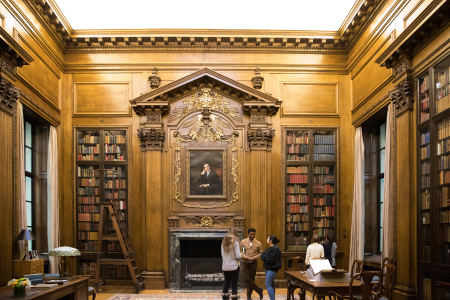
Pforzheimer Fellows are assigned a mentor from the library and work on Harvard Library projects under the mentor's supervision. While getting to know librarians and librarianship firsthand, they will be expected to assume responsibility for their projects. Each Pforzheimer Fellow will be awarded up to $6,000 to complete the project.
At the end of the project, the fellows will be asked to submit a final report of this work describing and evaluating their experiences. Fellows will also participate in discussions with each other about their experiences.
These fellowships are in honor of Carl H. Pforzheimer III for his generous contributions to Harvard and its libraries.
Things to Note
- Graduate students currently enrolled at Harvard are eligible to apply — not incoming or outgoing graduate students.
- Fellows work on defined projects. Work is performed under the mentor's supervision.
- Fellows are expected to assume full responsibility for their projects.
- Each fellow must submit a final report on their project, describing and evaluating their experiences.
- Projects must be based in Massachusetts and work completed while physically in Massachusetts.
- The fellowship is an hourly, paid role. Fellows will be responsible for submitting hours weekly.
- The fellowship runs for approximately 10 weeks, for a total of ~300 hours.
- Students holding a concurrent exempt (salaried) position are ineligible for this fellowship as it is a non-exempt position.
- Applicants understand the information on the Student Employment Office site, particularly that students can work no more than 40hr/week when classes are not in session.
- If applicable, students are responsible for discussing this fellowship opportunity with their financial aid advisor.
- International students are responsible for having the necessary work authorization to work at Harvard University in an administrative role (not a research or teaching role) that is paid hourly.
- Fellows understand that if any of their eligibility criteria changes during the fellowship their eligibility will be reviewed and may result in an early end of the fellowship.
Past Pforzheimer Fellows
2025 Fellows
- Natalia Neira Nieto: Mapping the World Music Industry
- Rebecca Mendoza: Uncovering Tozzer Library's Mesoamerican Codex Facsimiles
- Anna Vichkitova: Translating Yakut Fieldwork Description from Russian to English
- Corinna Anderson: Hollis Hall: Its History and People
- Courtney Gragson: Survey of Houghton Library's Native American Collections
- Jordan Vanderpool: Preserving the Academic Legacy
2024 Fellows
- C.R. Elliott: Wadsworth House: Its History and People
- Lauren Ehrmann: Thomas Jacoby Photographs of Early Christian Churches of Syria
- Johannes Makar: Thomas Jacoby Photographs of Early Christian Churches of Syria
- Ana Luiza Nicolae: Geospatial Data and Archival Research
- María Alejandra Privado: Celebrating the Radcliffe Choral Society at 125: An Archives-Focused Exhibit
2023 Fellows
- Brett Donohoe: Documenting the War in Ukraine with Internet-based primary sources
- Morgan Forde: connecting the Gutman Collections to the Black Teacher Archive
- Masoud Ariankhoo: Indigenous Studies of Near East, Middle East and North Africa
- Angélica María Sánchez Barona: The Legacy of Slavery in Houghton Library's Collection
2022 Fellows
- Donald Brown: Harvard and HBCUs
- Gangsim Eom: Urban Segregation
- Julia Harris: ACT UP Collection
- Johannes Makar: Finding Aids for Middle East Collections
- Kabl Wilkerson: Indigenous Peoples and Native American Exhibit
2021 Fellows
- Jessica Carbone: Women, Enterprise and Society: A Web Guide to Resources Project
- Sharri Hall: The Music of Black Americans Project
- Kate Mancey: Boston Rock City Project
- Meg Weeks: Hot-Button Issues Project
Contact
Practical questions concerning the application process should be addressed to Hannah Hack at hannah_hack@harvard.edu.
More general, academic questions concerning the program may be addressed to Professor Ann Blair at amblair@fas.harvard.edu.