Each year, Harvard Library’s Pforzheimer Fellowships provide an opportunity for graduate students to work on a library project with a librarian or archivist. This Fellowship offers a chance for recipients to learn about library careers, advance their own research skills, and get to know a library from the inside. Learn about the 2026 fellows and their projects below.
The History of the Harvard Science Libraries
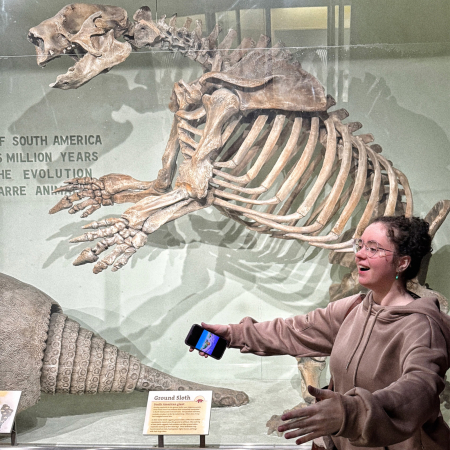
Lina Turygina, PhD Candidate — Slavic Department & G2 — Emigre Literature
Cabot Library
Library mentor: Amy Van Epps
Cabot Science Library opened in 1973 as a part of the Science Center. Cabot provided a research library with particular support for the undergraduate curriculum. The library’s collections included the research collections from distinct special collection science libraries as well as the core undergraduate-level materials for all the sciences.
Lina researched these former individual specialized collections, including conducting interviews with long-term library employees to collect oral histories, and crafted collections webpages that are linked to Cabot Library’s website. These webpages and the accompanying research Lina completed to create the pages are critical not only for the historical information they provide on the science collections at Harvard, but also for researchers and students navigating the greater science collections landscape today. In addition, these specialized libraries reflect greater Harvard history due to the notable researchers and events that took place across these departments.
Botanical Nature Printing
Kate Schreiber, Master’s in Design Studies and Landscape (2027), Graduate School of Design
Botany Libraries
Library mentor: Diane Rielinger
To increase discoverability and access to the Botany Libraries’ recently digitized nature printed collections, Kate created a CURIOSity site. The site supports research and teaching across various disciplines including botany, the history of science, the history of botanical illustration, and art and art history. Nature prints are illustrations created through contact with the surface of the object itself, often using a mold. Nature prints and photography effectively aim to remove the human hand from the study of nature.
Kate’s work focused specifically on nature prints from 18th-century Germany and 19th-century Austria and Britain. She also researched nature-printed materials across the Harvard Library collections, laying the groundwork for building out the site to connect as much of the Library’s holdings as possible.
Unlocking Biodiversity Data in Field Notebooks
Mohit Mandal, PhD Candidate — Anthropology
Ernst Mayr Library
Library mentor: Joe DeVeer
Natural history manuscript and archival collections contain irreplaceable scientific and species data that document biodiversity, ecological conditions, and human-nature interactions across centuries, enabling researchers to study ecosystems and monitor climate, habitat, and species change over time. This project expands access to critical ornithological data in the field notebooks of Walter Faxon (1848–1920), held in the Ernst Mayr Library’s archival collections. Faxon was an American ornithologist and invertebrate zoologist who served as curator of the Museum of Comparative Zoology’s invertebrate department from 1874 until his death in 1920.
Mohit investigated the use of handwritten text recognition (HTR) and AI-powered transcription tools to analyze and extract biodiversity data contained in Walter Faxon’s field notebooks. Through this work, Mohit created transcriptions of Faxon’s observations, identified relevant species and observational data, and uploaded datasets to global biodiversity digital repositories, including the Biodiversity Heritage Library and Global Biodiversity Information Facility.
Identifying Indian Boarding School Records at Harvard Library
Gavin Zempel, PhD Candidate — American Studies
Harvard University Archives and Gutman Library
Library mentors: Ginny Hunt and Alex Hodges
Working to support and in collaboration with the Mellon-funded Project Return at the Native Policy Lab at the University of Iowa, Gutman Library at the Harvard Graduate School of Education, and the Harvard University Archives, Gavin identified records and other materials in Harvard’s collections that relate to the history of Indian boarding schools in the US and the experience of Indigenous communities who were living survivors of these schools. Project Return has asked Harvard to share scans of primary source materials in its library collections about these schools and survivors to add to a portal for living survivors of Indian boarding schools to have access to information that would provide background on these schools and/or experiences in them.
Indigenous Language Manuscripts
Rebecca Mendoza, PhD Candidate — Committee on the Study of Religion
Tozzer Library
Library mentor: Susan Gilman
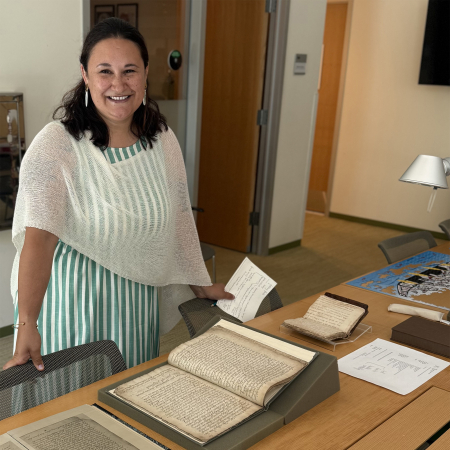
Tozzer Library holds Mesoamerican Indigenous language manuscripts that are invaluable resources for both scholars and language learners. Building on work she completed last year as a Pforzheimer Fellow to uncover and research this manuscript collection, Rebecca generated content for a CURIOSity digital exhibit that delves deeper into the content represented across the manuscripts. This is a comprehensive site for users to explore materials from Tozzer and related holdings from repositories across the Harvard Library system. Rebecca also created content for Tozzer’s main website, as well as a LibGuide for Mesoamerican Studies to increase discoverability of these materials and information on how to access them.
Promoting Music Special Collections: Choose Your Own Adventure
Maria Alejandra Privado, PhD Candidate — Music
Eda Kuhn Loeb Music Library
Library mentor: Elizabeth Batiuk
In preparation for an upcoming exhibition on the Rubén Blades Collection, Maria Alejandra researched both the singer-songwriter himself and contextual Panamanian history. This work informed the second phase of the project, curating the exhibit. Maria selected the materials, contributed to the final decisions on display layout, and wrote the accompanying text for the the three exhibit themes and object labels. She also curated a playlist of Blades' music from recordings held in Harvard's Archive of World Music, creating a multi-dimensional exhibit experience for viewers and users to increase their awareness of both the library and Archive of World Music's holdings.