The Harvard-Yenching Library stands as one of the world’s premier collections of East Asian research materials, with roots stretching back one and half centuries.
Its origins date to 1879, when the Chinese scholar Ko K’un-hua (Ge Kunhua) arrived at Harvard to teach the University’s first Chinese-language courses. He brought with him a small collection of Chinese books, which he later donated to the Harvard College Library. In 1914, two Japanese visiting scholars from Tokyo University — Hattori Unokichi and Anesake Masaharu — further enriched the collection with additional East Asian materials. Together, these early acquisitions formed the nucleus of what would become a major research repository.
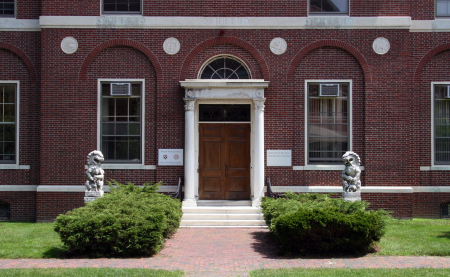
Significant growth began in the 1920s. In 1925, Alfred Kaiming Chiu joined Harvard as the first custodian of the Chinese-Japanese collection. Three years later, in 1928, the Harvard-Yenching Institute was established with funding from the estate of aluminum magnate Charles M. Hall, through connections with Yenching University in Beijing. The institute aimed to promote higher education and cultural exchange in Asia while strengthening East Asian studies at Harvard. Soon after its founding, it assumed responsibility for the University’s East Asian holdings, renaming them the Chinese-Japanese Library of the Harvard-Yenching Institute. Initially housed in Boylston Hall, the library moved in 1958 to its current location at 2 Divinity Avenue in Cambridge, a building originally constructed in 1929 for Harvard’s Institute of Geographical Exploration.
In the decades that followed, the library expanded dramatically through sustained acquisitions in China, Japan, and, later, Korea. Korean materials, first collected in the early 1950s, grew substantially over time. In 1965, the library was renamed the Harvard-Yenching Library, and, several years later, a Vietnamese collection was formally added. By 1976, when the library was reintegrated into the Harvard College Library system, it had become a major center for Asian studies, supporting scholarly research, teaching, and learning at Harvard and beyond.
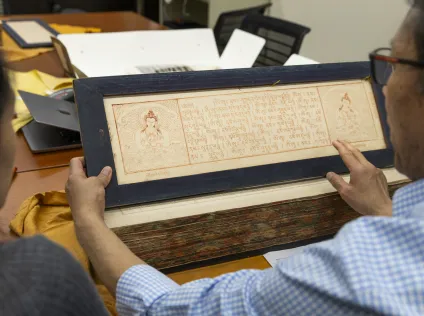
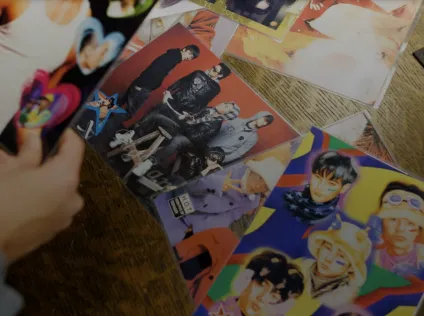
Today, the Harvard-Yenching Library holds more than 1.7 million volumes in Chinese, Japanese, Korean, Vietnamese, Mongolian, and other East Asian languages. Its collections also include rare books, manuscripts, rubbings, photographs, maps, microfilms, audiovisual materials, and digital resources, serving scholars worldwide as an indispensable resource for the study of East and Southeast Asia.
Staff Directory
Librarian's Office
- Jidong Yang 杨继东, Librarian
- Gloria Cadder, Administrative Coordinator
Access Services
- Johnny Weyand, Access Services Librarian & Collection Management Strategist
- Andrew Burke 安柏格, Access Services Coordinator
- Adrianne Gren, Access Services Coordinator - Collection Management, Course Reserves
- Sadiya Gurhan, Collection Management Assistant
- Wai Fan Leung, Library Assistant
Special Collections
- Yuzhou Bai 柏宇洲, Special Collections Librarian & Archivist
- Annie Xi Wang 王繫, Curatorial Assistant
Reference & Research Contacts
- Sharon Li-Shiuan Yang 楊麗瑄, Public Services Librarian- General Reference, e-Resources & Digital Scholarship
- Xiao-he Ma 马小鹤, Chinese Studies Librarian
- Kuniko Yamada McVey 山田久仁子, Retired Japanese Studies Librarian
- Mikyung Kang 강미경, Korean Studies Librarian
- Chan Thi Ngoc Phan, Vietnamese Collection Librarian
Policies
Group Tours
Harvard-Yenching Library offers tours for academic programs and campus-affiliated groups. Tourist groups cannot be accommodated.
To request a tour, email hylref@fas.harvard.edu.
Photography & Filming Policy
Digital photography of non-rare materials for research purposes is permitted. Any commercial or public-facing filming requires prior approval. Use of Harvard’s name, insignia, or imagery is strictly regulated, and all projects must comply with University policies on privacy, branding, and campus access.
See the Press, Photo and Film Requests for details.